An email open rate is a metric related to email industry data. This content will discuss what an email open rate is, alongside its formula and calculation. You will know the average and good open rate for email marketing. Also, find charts showing the average Open Rate for emails by industry and weekdays. And if your business is suffering from a low open rate, then find the causes and get a solution on how to improve Email Open Rates.
What is the Open Rate of Email?
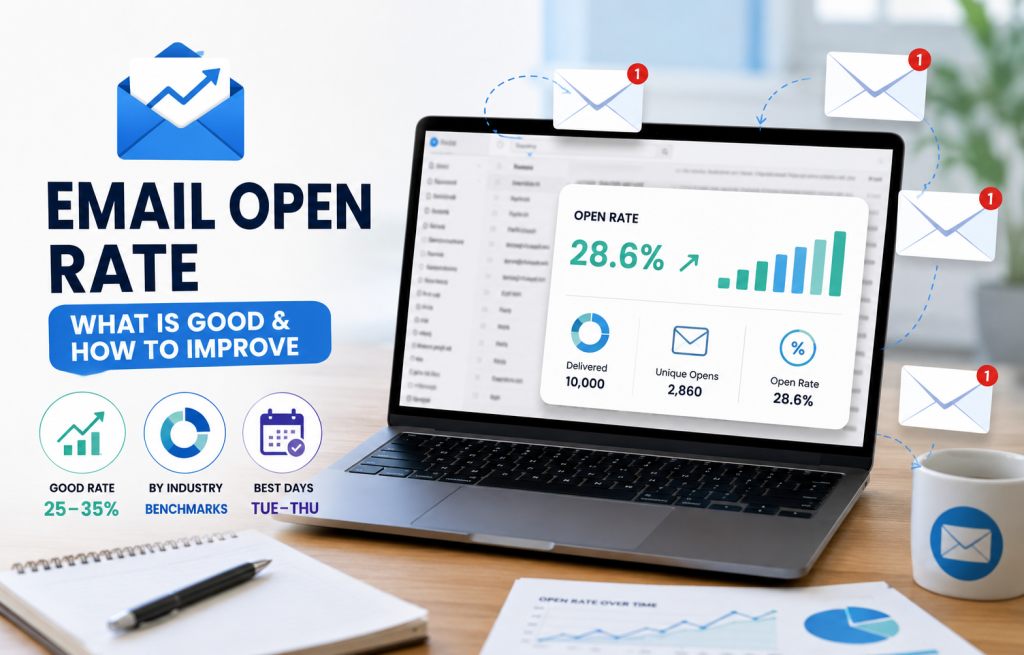
Email Open Rate is the percentage of successfully delivered emails that recipients actually open. This metric indicates how well your subject lines capture the attention of recipients. Also, it reveals how interesting your content is to the audience.
Open Rate Email Formula
Email Open Rate = (Number of Unique Opens ÷ Number of Delivered Emails) ×100
{Number of Unique Opens ÷ (Total Emails Sent – Bounce Back Email)} ×100
The term Delivered emails minus the bounced back emails from the total number of emails sent. (The total emails sent – bounced back emails).
Unique Opens count how many unique/different recipients have opened your mail. It doesn’t count multiple openings from the same user. Instead, it counts 1 for every recipient who has opened at least once (or multiple times).
Email Open Rate Calculator
Suppose you have sent a total of 11,000 emails, but 1,000 got bounced back, and the remaining 10,000 were successfully delivered. Among those, 2,500 were opened by unique recipients. The Email Open Rate Calculation in that scenario would be:
(2500 ÷ 10,000) ×100 = 25%
In a detailed equation:
{2500 ÷ (11000-1000)} ×100 = 25%
What is a Good Email Open Rate in 2026?
In 2026, a “good” email open rate typically ranges between 25% and 35% based on various sources, including the AI analysis. Popular platform Brevo conducted a study to find an average open rate across industries of 31.2%. However, the rate goes to 33.6% when counting the marketing and advertising campaigns. Klaviyo also came up with an average opening rate of 31%. The average open rate for email marketing is 28.6% based on MoEngage. They unveiled the lowest opening rate of approximately 14% and the highest rate just going pass 42%. Benchmark Email suggests an overall average email open rate of approximately 25.55%. Forbes revealed an average email marketing opening at 36.5%. Meanwhile, PipeDrive suggests a good email open rate based on industry, varying between 20% and 30%. MailerLite considers a good open rate for email marketing at 43.46%.
Overall, based on the current context, MailPai suggests that if your Open Rate reaches 20% for a normal context and more than 25% for a marketing campaign, then it’s okay. But you should aim for something between 25% and 35% or even more with proper usage of tools and procedures. However, transactional emails have a much higher opening rate, which might reach 80 to 85%.
| Sorts | Good Email Open Rates |
| What is a Good Email Open Rate for Non-Profits | Between 25% to 30% |
| What is a Good Email Open Rate for LinkedIn Newsletter | Between 40% and 50% |
| What is a Good Email Open Rate for B2B | Between 20% to 30% (Over 35% is Excellent) |
| What is a Good Email Open Rate for eCommerce | Between 30% and 40% |
| What is a Good Email Open Rate for Substack | Between 30% to 50% |
What is the Average Open Rate for Emails by Industry?
Here is a chart based on the average email open rate by industry in 2026. (Source: Insider One).
| Industry | Average Email Open Rates |
| SAAS | 15% to 45%, often 20-30% |
| B2B / SaaS services | 35% to 45% |
| DTC / E-commerce | 32% to 42% |
| Nonprofit | 25-32% (up to 40% with personalization) |
| Construction & Field Services | 20% to 40% |
| Marketing agencies | 18% to 35% |
| Personal Finance | 30% to 35% |
| Energy | 34% to 41% |
| Retail | 15% to 38% |
| Health/Wellness Sector | 28% to 44% |
| Culture and Tourism | 28% |
| Freelancing & Coaching | Approximately 40% |
Here is the minimum average email open rate chart of different industries based on a study conducted by Campaign Monitor.
| Industry | Minimum Average Email Open Rates |
| Retail | 17.1% |
| Restaurant, Food & Beverage | 18.5% |
| Wellness & Fitness | 19.2% |
| Professional Services | 19.3% |
| Government & Politics | 19.4% |
| Consumer Packaged Goods | 20% |
| Travel, Hospitality, Leisure | 20.2% |
| Advertising & Marketing | 20.5% |
| Education | 20.5% |
| Real Estate, Design, Construction | 21.7% |
| IT/Tech/Software | 22.7% |
| Healthcare Services | 23.7% |
| Logistics & Wholesale | 23.4% |
| Media, Entertainment, Publishing | 23.9% |
| Nonprofit | 26.6% |
| Financial Services | 27.1% |
| Agriculture, Forestry, Fishing, Hunting | 27.3% |
| Other | 19.9% |
| Average | 21.5% |
Various tools claim that they can help you obtain a much higher open rate through their proper assistance.
| Industry | Average Achievable Email Open Rates |
| B2B Services | 39.48% (Klaviyo) |
| Retail Email Marketing | 38.58% (Klaviyo), 32.59% (MoEngage) |
| Nonprofit | 46.49% (Brevo) |
| Behavior-based Personalization | 39.7% (MoEngage) |
| Hospitality & Travel | 45.21% (MailerLite) |
| SaaS Email Marketing | 38.14% (Active Campaign) |
| Banking & Finance | 27.42% (MoEngage) |
| Media & Entertainment | 25.78% (MoEngage) |
Top 10 Industries with Highest Email Open Rates
Forbes has unveiled the top 10 industries that gain the highest email open rates.
| Top 10 Industry | Peak Email Open Rates |
| Faith-Based Organizations | 45.50% |
| Child Care Services | 44.80% |
| Family and Social Services (government, adoption, pet care, elderly care, etc.) | 42.70% |
| Nonprofit Membership Organizations | 42.30% |
| Nonprofit Services | 41.80% |
| Recreation, Sports & Entertainment (Yoga studio, bowling alley, etc) | 41.80% |
| Independent Artists, Writers, and Performers | 41.40% |
| Education | 40.20% |
| Home & Building Services (cleaning, landscaping, contractors, construction, etc.) | 39.30% |
| Dining and Food Services | 37.60% |
What Day is the Highest Open Rate for Emails?
According to MailChimp, Mid-week days like Tuesday, Wednesday, and Thursday generally offer you better open rates than days like Monday or Friday. iContact suggests that Tuesday typically sees the highest open rates. Customer.io also agrees to rank Tuesday as the best day for email open rates.
A Klaviyo study had found the following results for a minimum average email open rate back in 2024/25.
| Day of the Week | Minimum Average Open Rate (Klaviyo) |
| Saturday | 11.29% |
| Sunday | 11.68% |
| Monday | 12.42% |
| Tuesday | 12.52% |
| Wednesday | 12.49% |
| Thursday | 12.43% |
| Friday | 12.14% |
MailerLite revealed the highest open rate for marketing campaigns based on weekdays in December 2025, and it stands like this:
| Day of the Week | Highest Open Rates for Email (MailerLite) |
| Saturday | 46.92% |
| Sunday | 47.03% |
| Monday | 47.62% |
| Tuesday | 47.38% |
| Wednesday | 46.94% |
| Thursday | 46.65% |
| Friday | 47.48% |
What Type of Email has the Highest Open Rate?
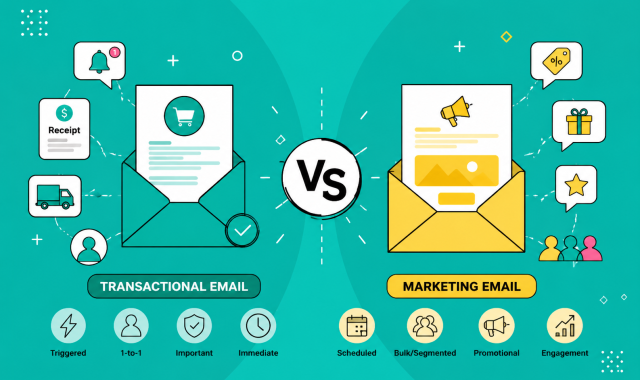
Basically, the welcome mails and transactional mails have the highest open rates, with newsletters and promotional campaigns having comparatively lower open rates.
| Type of Emails | Lower Avg. Open Rate | Higher Avg. Open Rate |
| Welcome Emails | 35-50% | 60-85% |
| Transactional Emails (e.g., order confirmations, password resets, shipping updates) | 30-40% | 45-80% |
| Newsletter / Content Updates | 15-25% | 30-45% |
| Promotional Campaigns | 15-25% | 20-35% |
Why is my Open Rate so Low?
Primary causes of low open rates may include mail landing in the spam folder, poor subject lines, or outdated subscriber lists.
Lack of Authentication: If you are sending through major providers like Gmail or Yahoo, you must ensure proper DNS records, including SPF, DKIM, and DMARC.
Sender Reputation: Repetitive spam landing degrades the domain reputation. Indeed, if you attempt to send from generic email addresses, those seem automated.
Inactive Users: A fatigue list full of inactive subscribers or recipients who haven’t even opened a mail in the last 3 to 6 months will just keep decreasing the opening rate and won’t bring fruitful results at all.
Purchased Lists: A red line to these third-party or purchased lists. They feature terrible address quality and eventually result in high bounce rates and spam reports.
Generic Messages and Not Personalized: The generic messages often fail to spark curiosity among audiences. Lack of personalized content results in lower open rate.
Spam Triggers: Usage of excessive exclamation points or trigger words triggers the spam filter. Examples? “FREE,” “Act Now”
How do you increase your Email Open Rate?
Here are some proven but secret techniques to increase or improve your email open rates.
Subject Line between 20 and 40 Characters
Emails with higher opening rates (around 45%) featured subject lines containing between 20 and 40 characters. Indeed, the length of your subject definitely affects the opening rate. You can notice that Mobile inbox apps like Gmail and Apple Mail show around 30 characters of a subject line. Your subject line must highlight the focus point of the body of the content, but shouldn’t be excessively long.
Segment, Group, or Filter Subscribers
Campaigns that performed well were 28% more likely to use subscriber filters. Targeted mail sending can be really effective, rather than group and blast or generalized messages that fail to spark interest to generate a higher open rate.
Preheader Fulfillment
When you’re checking your emails via desktop or laptop inboxes, you can notice a text next to the subject line. On the contrary, the line shows up under the subject line in mobile inboxes. That’s the email preheader. Fill that in to highlight the value of your email.
Time Maintenance
It’s crucial when you are sending. We’ve already revealed that Tuesdays had comparatively better open rates. In the Western countries, the highest engagement came during 8 AM and 11 AM local time. Meanwhile, on Fridays, the peak opening time was after 6 pm. But that will vary for countries like Bangladesh where Friday is the weekly holiday.
Personal Sender Name
It makes the message more personal rather than generalized, using “sir or business name or formal usage like to whom it may concern”. It somehow increases the opportunity to interact. Personal sender name increased the open rate by 3.81% in that MailerLite campaign.
Using Automation with Manual Input
Automated emails might trigger spam filters if you don’t provide input. But your valuable input can make it outperform general campaigns. The first welcome email sent to new subscribers came with a 53% higher opening rate than the normal campaigns. Just touch it up to make the best of it.
Usage of Emoji in Subject Line
Subject lines with emojis performed 21% better according to MailerLite. It makes the mail more catchy and increases the open rate.
Experimenting with Email Cadence
Experimenting is a must for a successful campaign and increasing the open rates or other positive metrics. How often you send emails to your subscribers is known as the Email Cadence. It can really impact the open rate. Daily senders had an open rate of 30.05% while the senders who sent once a month or less, grabbed an open rate of more than 35%.
Dispel Inactive Subscribers
This is one of the foremost duties to increase your open rate. Recipients who don’t open your mail must be removed, or you must stop sending to them. It may not increase the actual number of openings, but will definitely increase the open rate. Get rid of inactive subscribers as soon as you can.
Avoiding Excessive Links
The number of links also highly impacts the open rate. A MailerLite study revealed that their average open rate was 31% while emails with 2 to 5 links had the highest open rate of 34.17% (3.1% more). On the contrary, mails which featured over 20 links came up with the lowest open rate (around 22%).
Resend to Unopened
Sometimes you find that many of your recipients who had previously opened your mail haven’t done that during this campaign. You can try resending to give them another opportunity. You may tweak the timing. Or you can also go with a different subject line. Studies tell that the first send brings in 25% opening while the 2nd sent may bring you other 15%. So, that’s not a bad number at all.
FAQs
We answer some frequently asked questions on the Email Open Rate.
What is a normal open rate for emails?
A normal email open rate typically ranges between 15% and 25%. However, it widely varies based on the type of mail and the industry. Welcome mails and transactional mails have higher open rates than newsletters or promotional campaigns.
Is a 20% open rate good?
20% email open rate is generally considered solid and normal across most industries. However, one may still look for a better open rate. But an open rate of 20% is in the ok line.
Is a 45% open rate good?
Yes, a 45% email open rate is very good. It means out of your 100 delivered emails, 45 are getting opened by unique recipients. That’s better than the higher average in 2026.
Are email open rates reliable?
Nope, they are no longer reliable for measuring true engagement. Major causes include Apple’s Mail Privacy Protection (MPP), Security Bots, Image Blocking, etc. Instead of focusing on open rates, you can go for alternatives like click-through rates (CTR) or click-to-open rates (CTOR).
What is a successful email open rate?
It varies based on industry and type. However, basically 15-25% is average, and over 25% might be considered a successful open rate.
Why is my email open rate above 100%?
Basically, an email open rate can’t exceed 100% mark. It’s the ultimate line. But if your email open rate is above 100%, that means the tracking pixel is firing multiple times per recipient. In simpler words, it happens when more people open the email than receive it. Some crucial causes include Apple Mail Privacy Protection, Corporate Security Filters, Multiple Opens, Self Opens, etc.
Are email open rates falling?
Reports suggest that email open rates are falling quite frequently. However, experts consider it a technical measurement issue rather than a true decline.
Is email losing popularity?
Nah, indeed it’s gaining popularity. Statista revealed that 306.4 billion emails were sent on a day back in 2020, and the number rose to 376 billion per day in 2025. Right now, the amount is approximately 392.5 billion mail per day and still increasing.