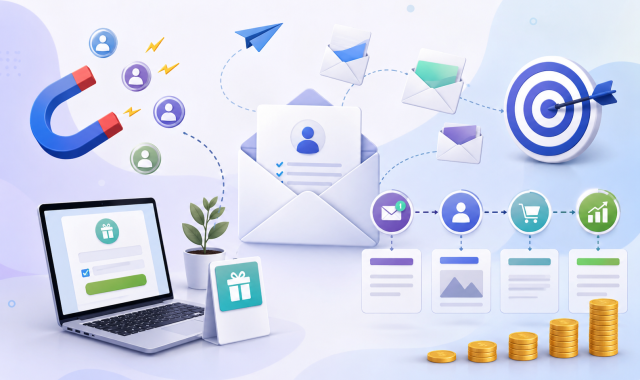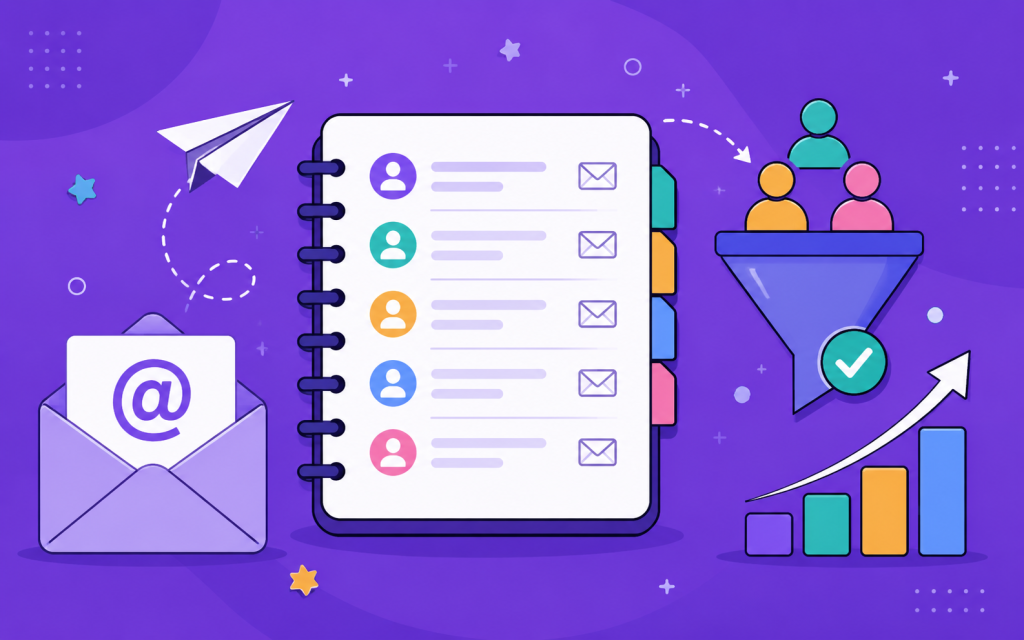
How do I build my own email list? How to Create a bulk email list? Or, what is the purpose of a contact list? Are you looking for the answers to these questions? If you are, then you have come to the right place. You will know everything regarding an email contact list: what it is, its benefits, usages, steps, and 15 proven techniques to build or create it successfully.
What is an Email Contact List?
An email list is a collection of individuals who’ve agreed to receive your emails in their mailboxes. In other words, it is a collection of email addresses grouped together, enabling you to send a message to multiple recipients simultaneously. Moreover, in email marketing, the term mail contact list refers to a compilation of email addresses that a business or marketer uses to send messages, updates, or promotions for marketing purposes. Simply, this is a list of emails that allows you to transmit an email to multiple recipients at the same time.
Your list must include the email address, but you can also add First name, Last name, Gender, Age, Phone number, Email sign-up form, Location, Preferences, etc. An email list can be of different types, including Personal or Group Lists, Permission-Based (Opt-in) Lists, Segmented Lists, etc.
How to Make a List of Email Contacts?
Let’s find out the basic steps that will help you build an effective list of email contacts.
| No. of Steps | Task in the Step | To Dos |
| 1st Step | Set up of the email infrastructure | Choosing a better Email Service Provider (ESP), Custom Domain Set Up |
| 2nd Step | Creating Compelling Incentives | Exclusive Offers, Lead Magnet |
| 3rd Step | Strategic Placement of Sign-up Forms | Attaching Subscribe Forms, Dedicated Landing Page, Linking Social Media Pages |
| 4th Step | Organizing and Protection of the List | Grouping and Segmenting the List |
How to Create an Email Contact List
Here are 15 Proven Techniques to create, build, or make an email contact list:
Opt for the Right Email Service Provider or Email Marketing Software
It’s one of the foremost tasks to build and manage a good contact list. An ESP will provide you with features like Sign-up forms, Email marketing templates, Segmentation, Email design tools, Automation, List cleaning, Email APIs, Email testing, Statistics, Engagement metrics, etc. You should search for a tool that gathers contacts in a customer relationship management (CRM) software. Integration with digital marketing channels (e.g., SMS, WhatsApp, Chat) will also help. Brevo offers signup forms, a drag-and-drop email builder, as well as up to 100k contacts.
Determining the Usage of the List
Determine the purpose behind your email list. Do you aim to make revenue with promotional campaigns or want a service to deliver transactional mails? Moreover, whether you are looking to onboard new clients or nurture leads through newsletters. Indeed, your offer or your sign-up forms all rely upon the purpose. Without a purpose, your strategy would be like an aimless life.
Set up of an Email Preference Center
Instead of waiting, you should build it from the initial stage, keeping the audience’s demand in mind. This tool helps to establish a good communication cadence with the subscribers. They can easily manage their emails. One may not love to get promotional messages, but could prefer to receive newsletters or vice versa. The email preference center improves deliverability and email list management. Ask them for what they want instead of taking action by yourself only.
Right email list opt-in option
Single opt-in takes a single step, but it could be really dangerous. Confirmed opt-in lets the subscriber receive a confirmation welcome email or a series of emails when they opt in. Pre-selected opt-in offers the users a preselected subscription checkbox to receive promotional emails. Preselected opt-in with confirmation is another option, which, when an individual keeps the preselected opt-in checkbox intact, sends them a confirmation email. Another option that gives recipients the option to agree to receive email from third parties is known as the Co-registration. Meanwhile, Double opt-in needs a secondary action from the user to ensure his subscription to the mail list. Experts consider it the best option.
Present with an attractive offer
Why would someone subscribe to your list? Well, what would you love to get as a recipient? Think like the audience. You can offer something that would attract recipients to subscribe. Offering a Lead magnet, Free shipping, Timely information, Discounts, Exclusive content, etc would be effective.
Collecting mails at checkout
Collect mails to provide customer account notifications and shipping updates. Then offer them a checkbox option to join your list. Oh wait! Someone will not even check it without any purpose. Remember the offers we’ve suggested in the previous point. Try to attract them with those offers.
Add Call-To-Action (CTA) Buttons
The addition of CTAs on every landing page throughout your website or blog posts would help organic website visitors sign up for your email list. Try catching their attention with CTAs like “Sign up for our mail list to get special offers.” You may place the CTAs in the body or the ending part of your blog. Offer them a free trial or free e-book.
Promote signups on social media platforms
Promoting your newsletter across your email and social media accounts will help grow your email list. In your social media posts, attach a link to your signup form. Social media giveaways or contests can be a handy option to gain many subscribers.
Pop-up Forms
If the audience doesn’t find the X button easily, it can actually annoy them. They can even leave with a bad experience. But we still suggest you try this. If testing the pop-up forms doesn’t affect the audience’s time on page and the bounce rate, then you can carry on with it.
Dedicated Landing Page
Offering the sign-up or opt-in option through a dedicated landing page form will let users opt into your list. The audience can notice your email offerings and let the potential subscribers choose whether to opt in or not.
Converting emails into subscribers
There might be many mail users who are in your list and previous users of your products, but they have yet to subscribe. Hence, they haven’t yet opted to receive promotional messages, transactional emails, newsletters, or product announcements. Try to convert them into subscribers. Offer them options, what sort of messages they want to get from you.
Offline list building
Don’t keep your email list confined to online sources. Various offline campaigns can really help you build an effective mailing list. You attend various programs, shows, or events. Give the attendants a form and take their mail alongside some other information like blood group, hobbies, matters of interest, etc.
PPC advertising
PPC refers to the Pay-per-click, which processes sending traffic to an email capture page directly through your main advertisement. Investment in PPC can bring you new subscribers, but keep in mind factors like PPC landing page, Responsive search ads (Google’s newest ad format), and Audience targeting (based on keywords, device type, and location).
Converting Social Media followers into subscribers
Many of your social media followers may not even know about your email campaign. A simple post or pinned post on your social media could be a great way to inform them. Ask your social media followers to subscribe to your email list.
Metrics Monitoring
Just building a larger list is not the ultimate goal; instead, focus on the performance. Indeed, inactive subscribers would degrade the positive metrics and would impact your sender reputation. Hence, check out the performance health and take action as required. Assessing metrics like the Deliverability rate, Open rate, Click rate, Unsubscribe rate, Spam rate, New subscriber growth rate, etc., will help you make decisions and will show the true performance of your list.
Is Buying an Email List a Good Idea?
Buying an email list will provide you with email addresses, names, and other data about individuals who have agreed to receive affiliate mails. However, we often suggest that you don’t purchase an email list. Even if you do, you have to do it very carefully through completely authentic sources. Otherwise, buying an email list can cause you serious trouble, for instance:
- Purchasing an email list will most likely yield you poor results with lower Open rates, CTR, COTR, conversion, and more spam, bounces, etc.
- It may damage your sender’s reputation.
- Buying an email list also violates strict anti-spam laws like GDPR or CAN-SPAM.
- Increases the probability of being blocked by major providers like Gmail, Yahoo, etc.
- Email marketing services might suspend your account as well.
But if you ask about whether it’s possible to grow your business or make money through a purchased email list, then, yes, you can. But so much carefulness is required.
Can you Rent Email Lists?
A rented email list where the owner has complete control of the list, and the renter neither sees nor enters emails into their list. Instead, they actually rent a list from someone else for a predetermined period to send messages. A rented email list can also cause you the issues mentioned above.
However, one can still rent an email list or purchase it via authentic sources. This list can also help them grow and make money, to be honest.
What is an Email List Used for?
It basically helps you send the same message to multiple recipients at a time.
Onboarding: With an email contact list of clients, you can welcome the new customers with onboarding emails. There, you can also tell them about your services or show how to use your items.
Nurture: It will help businesses or agencies to build relationships with potential clients via email newsletters and drip email campaigns.
Transactional: The list will help you send transaction emails, including transmitting confirmation emails, password resets, account notifications, receipts, and more.
Promotional: Inform your potential and previous customers about product launches, discounts, coupons, and deals.
Automated Sequences: Automate welcome series, abandoned cart reminders, or customer onboarding emails and guide them for next steps.
Emergencies & Issues: You can also inform the clients about issues or emergencies (e.g., health, weather, threats, disaster, delay, suspicious account activity, etc.) through mail.
What are the Benefits of an Email List?
The email list is an asset for the marketing team. Emailing is the channel where subscribers give their consent to get messages from you. Which means they are interested and can be your potential client. Major advantages that an email list provides are as follows:
Complete Ownership: Unlike social media followers, your email list is completely owned by you. That’s why it is a permanent asset.
Measurable Insights: It eases the tracking of deliverability, open rates, and click-throughs in real-time. Thus, making future decisions becomes also easier.
Choice or Preference of the Recipients: Most users prefer emailing for business-to-consumer communication. Because it lets them make contact directly and helps avoid all the confusion.
Number of Users: Email is among the biggest platforms to communicate with users, with more than 4 billion users at the moment. The list helps you count the users, enable to easily calculate how many of them are getting what sort of messages.
User Acquisition: Reports tell that email is the primary customer acquisition channel for more than 80% of small and medium-sized businesses.
Organic reach: While Facebook posts only offer around 5.2% organic reach, the average email open rate is around 15-25% in most cases. The longer your list, the more reach for your business.
High Return on Investment (ROI): This channel provides you with a very high ROI of around $36-45 for every $1, which is much higher than any other alternative. Thus, build your list and grab a better ROI through email marketing.
Click-through rate (CTR): Where the average social media CTR is only around 0.88% to 1.55%, the CTR through emailing is almost around 2%. With a well-built, longer email list, you make more chances for CTR.
FAQs
Why do I need an email list?
Because it gives you direct, algorithm-free access to your audience. Moreover, it ensures long-lasting relationships and drives sales. Reasons include Audience Ownership, Guaranteed Visibility, Direct Communication, Automation, Targeted Personalization, etc.
Where do I find my email contacts list?
You can find your email contact list by navigating to Google Contacts on any web browser.
On your desktop: nine-dot grid icon (Google Apps) > contacts app or icon.
On handset: Google Contacts app (Android) or the Gmail app (iOS/Android) > menu > contacts.
What is an advantage of owning your email list?
It offers a complete, algorithm-free control over your audience. Major advantages include Direct Inbox Access, No Platform Risk, High ROI and Conversion, Audience Segmentation, etc.
How do I clean my email list?
Dispel duplicate and obviously invalid addresses (like typos in domains) > segment inactive users > resend to the unopened ones, and the unresponsive ones get complete removal.
How much is a 1000 email list worth?
The price varies depending on origin and type. For a 1k email list, the Consumer Lists charge around 100 to 400 dollars, B2B (Business-to-Business) Lists cost 300 to more than 1k dollars, while an organic list may come at around $100 to $500+ per month.
Can you make money from email lists?
Yeah, for sure. You can definitely earn money from an email list. This digital asset can provide an average Return on Investment (ROI) of up to $36 to $45 for every $1 spent.
How much can I sell my email list for?
As we’ve already said, one can get around 100 to $400 per 1,000 subscribers for consumer (B2C) lists, and $300 to $1,000+ per 1,000 subscribers for business (B2B) lists.
Can you legally sell emails?
As soon as people opt out of hearing from you via email, you can’t sell or transfer their email addresses.
Is it legal to purchase email lists?
Nope, indeed, you cannot legally use bought contacts to deliver unsolicited marketing emails without strict compliance with regulations like the CAN-SPAM Act. Without proper explicit consent, you can’t use a purchased mail list to send emails in regions like Canada or Europe.