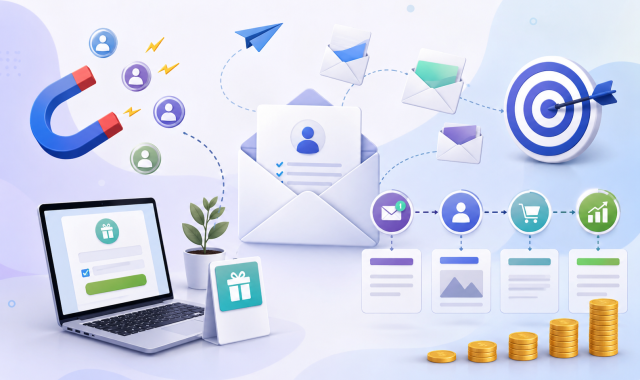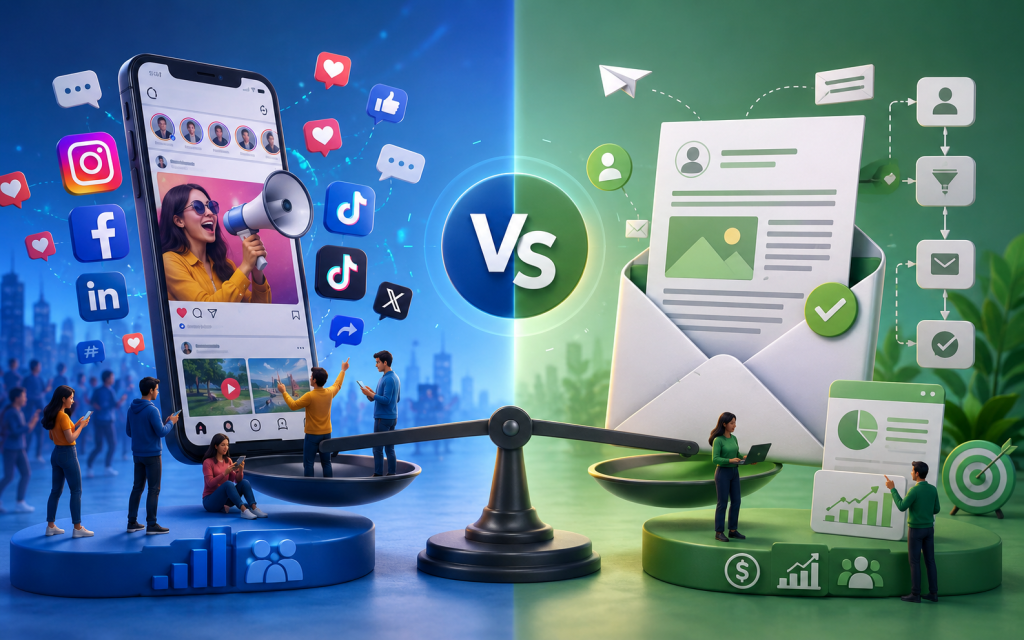
Social media marketing and email marketing are both digital marketing strategies. One may misconception that these 2 marketing strategies are rivals to each other. No, that’s a completely wrong idea! Instead, these 2 marketing tactics work hand-in-hand. However, there are some key differences between the 2 trickeries which both provide you with audience and sales. In this content, we will elaborate on what social media marketing and email marketing are, with key dissimilarities between the 2 and will also help you decide which one is better or a more handy option for you.
Social Media vs Email Marketing in 2026
See definitions, techniques, differences, and overall comparison between social media and email marketing.
What is Social Media Marketing?
Social media marketing is a digital promotional strategy that involves promoting your brand and products on platforms like Instagram, Facebook, LinkedIn, TikTok, X, etc. It looks forward to building a community and driving engagement. This marketing type utilizes a mix of organic posts (images, short videos, stories) and paid ads. The system is heavily dependent on the algorithm. Primary goals include brand or business awareness, discovery, audience growth, etc. You will get the best of it while looking for building brand value, customer interaction, and reaching new clients.
What is Email Marketing?
In this strategy, marketers send commercial messages, newsletters, or promotional offers directly to a targeted list of subscribers. The basic audience list features the subscribers who have agreed to get messages from that specific brand/businesses. As we’ve already mentioned, it delivers the message directly to the audience’s inbox and has nothing to do with the algorithm system, unlike social media marketing. Major objectives include the likes of lead nurturing, customer retention, and direct conversions. When you prioritize high ROI (Return On Investment), personalized conversation, segmentation of audiences based on test differences, etc., email marketing will benefit you.
Difference between Social Media Marketing and Email Marketing
| Aspects | Social Media Marketing | Email Media Marketing |
| Basic Principle | Promoting brands on platforms like Instagram, Facebook, LinkedIn, TikTok, X | Direct messages, offers, and newsletters to targeted subscribers or audience via email |
| Primary Goal | Brand awareness, discovery, & community engagement | Direct sales, lead nurturing, & customer retention |
| Audience Ownership | Platforms own the followers or audience list | Marketers own the audience or subscriber list |
| Content Lifespan | Shorter lifespan contents, with a brief shelf-life (algorithm moves it from the feed) | Longer lifespan: Messages remain in the inbox until the user deletes them |
| Control | Low control due to algorithms and ad budget orientation | Nothing to deal with algorithm changes or pay-to-play visibility restrictions |
| Strengths | Unparalleled organic reach potential, visual storytelling, and real-time community engagement | Higher Return On Investment, Conversions, & other Metric Performances alongside deeper personalization facility |
| Personalization | On broader aspects with paid ads, organic posts are the same for the entire audience | Deeply personalized messages based on specific user behaviors, past purchases, and names |
| Engagement Type | Public interaction metrics like likes, comments, and shares: provide Visibility | Better metric performances, like opens, link clicks, and direct replies with high intensity, provide value |
| Best For | Brand value & awareness, viral marketing strategy, build up of a community & public engagement | Direct promotional campaigns, automated customer onboarding or welcome series, abandoned cart sequences, and offering exclusive discounts |
| Tools/Platforms | Meta (Facebook/Instagram), TikTok, LinkedIn, X (Twitter) | Various SAAS (Brevo, ConvertKit, Mailtrap, Mailchimp, etc) and Self-Hosted Tools (MailPai, Sendy, Mautic, MailWizz, Mailcoach, etc.) |
| Average ROI | A strong budget is required for paid ads, and the return is lower | Higher return, around $36 to $42 for every $1 spending |
| Cost | Large-scale range (low, moderate, high) and many variables | Affordable and predictable cost |
Comparison of Performance Metrics between Social Media and Email Marketing
Open Rate / View Rate
Forbes cited a 36.5% average open rate, while the median open rate for MailerChimp is 43.46%. According to MaiPai’s Email Industry Data Report, the average open rate for email marketing is around 25-43%. On the other hand, Email Toolster suggests that an average audience reach or view rate through social media marketing is only 2-4%. Meanwhile, if you maintain a systematic process and use email marketing tools like MaiPai, most of your emails will land in the recipients’ mailboxes.
Click Through Rate (CTR)
Campaign Monitor generalized an average CTR of 2-5% for email marketing, although more specifically it ranges between 2.66% to 3.38% (MailChimp, Klaviyo). On the contrary, Average CTRs range from 0.9% to 2.0% for Facebook & Instagram, between 0.4% and 1% (LinkedIn), 1-2% (B2B Campaigns), 0.5-0.6% (YouTube), and within 1-3% for X and TikTok.
Conversion Rate
Email Marketing yields a magnificent conversion rate of up to 6-8%. On the other hand, the range is definitely not more than 3% for social media marketing. Indeed, you can reach mostly 1-2% via Paid ads, while the sum stays less than 0.5% if you choose the organic-only way.
Return On Investment (ROI)
No other business strategy can match email marketing on the basis of ROI, a whopping 3600-4200% on average ($36-42 for every $1). Social media marketing also offers a profit margin between 200-500% ($2-5 for every $1 Cost), but that’s really a mere amount compared to its counterpart.
Maximum Reach
Social media marketing offers you unlimited reach and allows you to take your brand to anybody at any place. While the email marketing audience is limited to the size of your contact list (although you can collect and build a massive list).
Unsubscribe or Ignorance
The unsubscribe or ignorance rate is lower for email marketing than social media marketing because your audience has chosen to hear or get messages from you via email. However, social media feeds almost force users to see the ads and hence are more ignored.
Email Marketing vs Social Media Marketing Comparison
| Performance Metrics | Email Marketing | Social Media Marketing |
| Open Rate / View Rate | Around 25-43% on Average | Only 2-4% (across platforms) |
| Click-Through Rate (CTR) | Between 2.66% to 3.38% | 0.9% to 2.0% (FB & Insta), 0.4% to 1% (LinkedIn), 1-3% (X, TikTok) |
| Return On Investment (ROI) | 3600-4200% ($36-42 for every $1) | 200-500% ($2-5 for every $1) |
| Conversion Rate | Up to 6-8% | Only 1-2% (Paid), Less than 0.5% (Organic) |
| Maximum Reach | Limited to the size of the list | Unlimited |
| Unsubscribe or Ignorance | Higher | Lower |
What are the Advantages of Email Marketing?
Take a look at the major Pros of email marketing over social media marketing.
Direct Reach: This strategy brings your business or brand directly to the audience. It lands your message in the recipient’s inbox rather than a common place where they can check it whenever they want. You can communicate directly with your potential clients.
Targeted and personalized communication: Enables you to communicate individually based on client response, choice/test, behavior, previous sales, etc. You can change the body of content from one recipient to another.
Full Consent: Your audience ensures complete consent or permission to get a message from you. So, no waste of mail, money, or time.
Ownership of Audience: You own the contact list or audience by yourself and have more control over your list. You can choose who you will send a message to.
Better Performance Metrics: You get far better open rates, click-through rates, ROI, and lower unsubscribe rates, and spark more interest among your audience for your content, products, or services.
Higher Sales: A higher conversion rate means you get more sales and more profit. That’s what businesses look for.
Low Cost and High ROI: Email marketing not only yields the best ROI of any strategy that exists in the digital world, but also offers various scale-based spending opportunities. From a small-scale business to a massive worldwide industry, there is room for every brand.
Measurability & Decision Taking Facility: Measurable results: through clear metrics and analytics, help you to measure the success of your marketing campaign and suggests you what to do for future campaigns.
What are the Advantages of Social Media Marketing?
Now, see the major pros of social media marketing over an email marketing strategy.
Wide Reachability & Brand Value: There are billions of monthly visitors on social media platforms like Instagram, X, Facebook, LinkedIn, Pinterest, YouTube, TikTok, etc. Hence, your audience size has absolutely no limit, and your brand can reach even more people.
Viral Potentiality: Its lot easier to spread information and increase reach through social media platforms. Through sharing, the audience themselves help to get you popularity and potentially more sales.
Visual Appeal: If you want to showcase your business or product, then social media is a better option as it focuses on visual appeal and also doesn’t affect you with a file size limit that you often face during email marketing.
Real-time communication: Enables you to respond quickly and get in touch with the clients more frequently.
Fast & Flexibility: Lets you test new ideas, campaigns, and content, and observe public reaction. If one idea doesn’t work, you can simply delete or temporarily remove it, or make only-me mode and then try another execution within a short period of time.
Community Build Up & Engagement: Social media platforms interconnect your audience base, and they can publicly share their thoughts on your business, products, or services. Indeed, your audience can work like an unpaid agent for you.
What are the Disadvantages of Email Marketing?
The major cons of email marketing include:
- Triggering Spam Filters
- Messages not getting delivered to the mailbox
- Client Fatigue due to Mail Frequency
- Risk of Unsubscribes
- Strict Privacy Regulations
- Technical maintenance and skills are sometimes required.
What are the Disadvantages of Social Media Marketing?
See, the cons of social media marketing:
- Algorithm-Controlled Reach and Nothing Upon You
- Short Lifespan of Contents
- Lower Conversion Rate
- Hyper-Competitive Environment.
Social Media vs Email Marketing: Which is Better?
First of all, we’d like to remind you that these 2 strategies are not rivals; indeed, they can work together and benefit each other. Social media provides you with the top facility for discovery and brand awareness. Meanwhile, email marketing is your best bet for nurturing leads and driving sales. A successful brand promoter doesn’t eliminate the scope of one strategy to embrace the other. Instead, they collaborate on the facilities of both strategies to capitalize on the opportunity.
For instance, you can collect loads of emails and user IDs through various social media platforms and can request them to be in your list. You can go for a social media promotion for your brand to reach a wider audience and build up community engagement. Then you can get back to them with personalized messages in their mailboxes and drive sales.
On the basis of performance metrics and spending, email marketing ensures better open rate, CTR, ROI, less unsubscribe rate, while social media marketing takes your business to a wider audience. Lower cost, personalized communication, ownership of audience, recipient consent, and campaign result measurability, etc., make email marketing a better option.
In one sentence, Email Marketing is the best option for conversions, while Social Media is the best channel for discovery. If you compare based on performance metrics and costing, email marketing will have the upper hand over social media marketing. Especially, self-hosted email marketing via tools like MailPai can take your business to a greater extent. And in a broader sense, strategize social media marketing and email marketing together to make your business or brand a successful one.