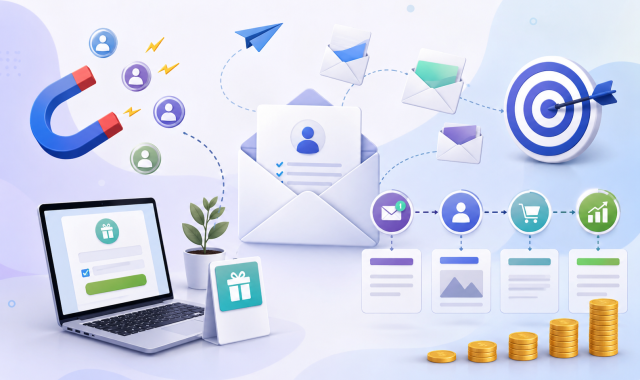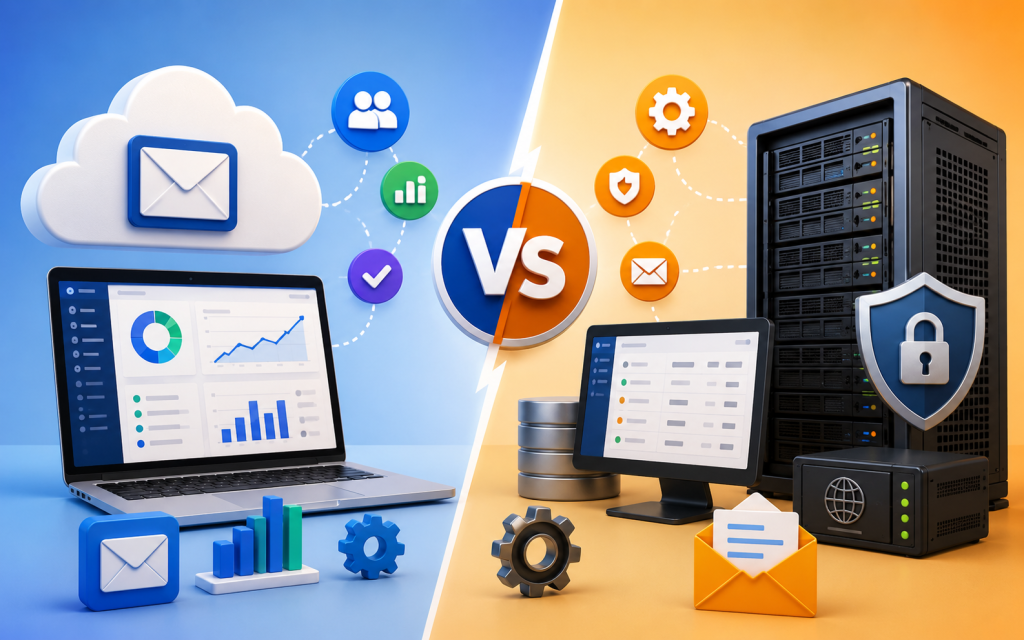
SAAS and Self-Hosted are types of email marketing tools. But there are basic differences between the two sorts in terms of facilities, working principles, costing, and others. This content is all about SAAS vs Self-Hosted Email Marketing tools, depicting the differences alongside mentioning all the advantages & disadvantages (pros & cons).
Table of Content
- Sass Vs Self Hosted Email marketing
- What is the difference between self hosting and SaaS?
- Advantages of using SaaS for Email Marketing
- Disadvantages of SaaS
- Benefits of self-hosted Email Marketing
- Disadvantages of email hosted Email Marketing
- SAAS vs Self-Hosted Email Marketing Cost Calculation
- Calculate cost per email
- FAQs
SAAS Vs Self-Hosted Email Marketing
The full form of SAAS means Software as a Service. This system maintains a process where the businesses take a platform for use in rent where the vendor manages the servers, software, and sending. Elaboratively, SAAS are plug-and-play service where the system runs on the vendor’s servers, and the vendor also manages everything. Users need to pay a subscription fee on a monthly or annual basis. Hence, they get the privilege to use the vendor’s platform, templates, and sending infrastructure. For instance, Brevo, Mailtrap, Mailchimp, ActiveCampaign, ConvertKit, MailOctopus, etc., are examples of SAAS tools.
On the other hand, in the Self-Hosted system, you download the software onto your own server and manage it completely by yourself. In other words, being a user, you download and install the software onto your own hosting account or private server. You also control the entire system as you are the admin of this system, but you only require to connect the system to a 3rd-party sending service. MailPai, which is a WordPress Plugin, is a very good example of a self-hosted email marketing tool. Other instances include the likes of Sendy, Mautic, MailWizz, Mailcoach, etc.
What is the difference between self hosting and SaaS?
| Features | SAAS | Self-Hosted |
| Basic Theme | Rented as a web service and managed by vendors. | Software/App/Script is being downloaded & installed, and run on the user’s own server. |
| Maintenance & Control | Vendor handles & controls the entire system. | The user or their team has full access and control privileges. |
| Time Length & Set Up | Instant Set Up system, all you need to sign up and use immediately | The system is comparatively slower: it requires manual installation & set up |
| Data Control | The vendor has the data control in their system | Your own infrastructure controls the entire data system |
| Pricing or Subscription Pattern | Based on a monthly or yearly rental or subscription pattern | Either you use an open source code or need to purchase the software license |
| Ideal for | Fast setups and non-technical or non-skilled users | Technical or skillful teams that can do the work by themselves would prefer this system |
| Customize Facility | Users can enjoy only what the vendor allows them | Unlimited customization allowed, as you get full access to change the code |
| List Size | Small to Medium | Very Large |
| Technical Skill | Beginner or amateur-level users | Expert or Pro-level users |
| Data Privacy | Provides standard data privacy, but there might remain a question mark | You control and handle the entire thing means you get high security for your data |
| Budget | Low initial spending | Low long-term cost |
| Examples | Brevo, ConvertKit, Mailtrap, Mailchimp, ActiveCampaign, MailOctopus, etc. | MailPai, Sendy, Mautic, MailWizz, Mailcoach, etc. |
What are Advantages of using SaaS?
Using SAAS for email marketing provides you with many advantages. The three major benefits are lower upfront costs, instant accessibility, and effortless maintenance.
Lower Upfront Costs
- No need to purchase any hosting, as you use the vendor’s servers, thus you get the benefit of not buying any servers or storage drives.
- Start with free trial with no cost the limited email sending.
- You also manage to get things done with a reduced internal IT infrastructure and management expenses.
Effortless Maintenance
- Maintenance can be done even without any skills, and hence, beginners can also do such tasks.
- Vendors have the responsibility to deal with all upgrades, bug fixes, and new features.
- When service providers make global security updates that don’t affect your workflow..
Immediate Accessibility
- The system doesn’t need a long installation time as the entire system is ready-to-use, and hence, you start working instantly.
- It gives you the privilege from anywhere through any device connected to the internet.
- Users can synchronize across devices, including computers, tablets, and smartphones.
What are the Disadvantages of SaaS?
Now, take a look at the major cons of SAAS.
Data Security: You neither store the data within your server nor control it. Hence, you have to trust a 3rd-party service for the security of your sensitive business data.
Internet Dependence: A high-speed, reliable internet connection is a must for these tools. Otherwise, it won’t work. Although in this modern world, it may not seem a serious issue, sometimes the internet may slow down or get disconnected.
Almost No Control: Vendors control the system, and update & feature changes are forced on you by the controllers. You can’t choose.
Limited Customization Facility: Businesses only enjoy what the vendor allows them and can’t customize the way they like.
Difficulty of Transferring to New Platform: If you have made up your mind to move to another platform or even move your data, the process might not seem easy to you.
Huge Long-Term Costs: Initially, you don’t need to spend the license fee, but as time progresses, you can find out the subscription cost gets higher than the one-off license fee payment.
Other Risks: If somehow the vendors’ server crashes, users will lose access to the tool.
What are the benefits of self-hosted email marketing?
Find out the pros of using self-hosted email tools.
Total Data Privacy: The complete management, storage, and access of data only belongs to the user and their team. No 3rd-party vendor can control or store data. Hence, there you get the ultimate security of your sensitive company data.
No User Limits: You can create & add as many email addresses as you want without any additional charge demanded by the vendors. No need to pay the monthly or annual subscription fee on a regular basis as well.
Customization Facility: Vendors or any other 3rd-party services can’t force you and won’t even limit your customization. You choose everything based on your taste & requirement. The choice of web interface, spam filters, and storage limits all belong to the user.
What are the disadvantages of self hosting?
Maintenance Issue & Skiils: Beginners need to learn few things to cope with this system, and all the maintenance responsibility is put on the users’ shoulders.
Deliverability Challenges: If you don’t choose the proven script, app or software for self hosted email marketing, you emails may end up in the junk folder & spam boxes. Major providers strictly maintain spam protections. Without technical setups like SPF, DKIM, and DMARC, you will face a deliverability disaster.
Reputation Risk: Without a proper systematic approach, your server’s IP address may be flagged as spam. In that case, your messages will bounce repeatedly and won’t reach their destination.
SAAS vs Self-Hosted Email Marketing Cost Calculation
Suppose you have a total of 50k subscribers to whom you will be sending mails, and each of your subscribers will receive a total of 4 monthly mails. In other words, for 200k monthly email sending, here is the cost calculation chart:
| Cost Category & Formula | SAAS Platforms | Self-Hosted Setup (Open Source + AWS SES) |
| Total Cost Formula | Monthly Subscription Tier | Monthly Server Fee + (Mails Sent ÷ 1000 × SMTP Rate) |
| Software/Platform Charge | 300-400 Dollars Per Month | $0 (Open Source) or $50 per month (Premium license) |
| Server/Hosting Spending | Count in the Platform Charge | $10-20 per month (Cloud VPS) |
| Sending/SMTP Expenditure | Count in the Platform Charge | 200k emails for $20 per month or 10 cents for 1k mails |
| Total Monthly Costing | $300-400 per month | Only $30-90 per Month |
If you are a beginner and only have a small list, then you can try the SAAS platforms. But if you have long-term plans with a plethora of emails and also have a skill or an expert IT team, then a self-hosted setup would be your best bet.
How to calculate cost per email?
Simply, you can calculate the cost per email by dividing your total email marketing expenses by the total number of emails sent.
| Cost Per Individual Email | Overall Campaign Cost ÷ Total Emails Sent |
| Cost Per 1,000 Emails (CPM) | (Overall Campaign Cost ÷ Total Emails Sent) × 1,000 |
| Cost Per Email Click (CPC) | Total Campaign Cost ÷ Total Emails Clicks |
FAQs
What are the top 5 SaaS companies?
Microsoft, Salesforce, Adobe, Oracle, and ServiceNow are the top 5 Software as a Service (SaaS) companies.
Is GMail a SaaS or Paas?
Gmail is a SaaS (Software as a Service). How? Gmail is indeed a complete & ready-to-use app where you just log in and use it.
What is PAAS?
Well, PaaS is Platform as a Service, which actually delivers a framework for developers to create software. Examples of PAAS are: Google App Engine, AWS Elastic Beanstalk, Heroku, etc.
Is ChatGPT considered SaaS?
Yeah, ChatGPT is considered Software as a Service (SaaS). ChatGPT is basically a fully built software app that users use through a login from anywhere. It may charge them a subscription fee.
Is Facebook a SaaS company?
Actually, we do not consider Facebook as a SAAS company. SAAS companies actually sell or rent software to businesses in exchange for a monthly or annual subscription fee. SAAS companies examples: Salesforce, Zoom. Facebook is a free platform for the user, and they actually sell targeted advertisements to businesses to earn.
Is Netflix a SaaS or PaaS?
Netflix is also a SAAS as it is ready to use, runs on a Cloud-Hosted model, and uses a subscription method for users to get a login immediately and use.
Is Outlook a SaaS or PaaS?
Outlook, too is considered a SaaS (Software as a Service). The reason you may know is that it is also a ready-to-use, fully-functional app that users can access all over the internet.
What is the 3 3 2 2 2 rule of SaaS?
These numbers represent the revenue growth benchmark. It suggests the startups to triple their annual recurring revenue (ARR) for two years (Years 1 and 2). Then to double it for the next three years (Years 3, 4, and 5)
Is SaaS a B2B or B2C?
SAAS can be both B2B (Business-to-Business) or B2C (Business-to-Consumer). The working principle remains the same, only the target audience makes it either B2B or B2C. In B2B models, the target audience is companies, teams, or departments who sepnds at a high cost (Hundreds to thousands of dollars) and have a low churn rate. Meanwhile, in the B2C model, individual people spend at a Low cost (Free apps to under $10/month) and a high churn rate.
What skills are needed for SaaS?
Customer development, Roadmapping, AI/Prompt Engineering, Go-To-Market (GTM) Strategy, Value-based Selling, Inbound Marketing & SEO, Cloud & DevOps Basics, API Integrations, Data Analytics, etc.
Can I host my own email server?
Yes, you can host your own email server. It will provide you with complete privacy and will let you control your data.
What is the best self-hosted email server?
Actually, there is no specific best, to be honest. MailPai, a WordPress login, is gonna be a top choice as a self-hosted email. For established names, Mailcow and Mail-in-a-Box can be good choices. Mail-in-a-Box is a good option for beginners, while Mailcow provides more advanced features.
Is self-hosting a good idea?
In terms of data privacy, full control, and learning opportunities, self-hosting can be a tremendous idea. However, you may not like it if you prefer convenience, don’t have time for maintenance, and are unable to handle downtime.
How much does it cost to host an email server?
Hosting an email server may cost you nothing (open source) to over $50 per month.
| Completely Free Open Sources | 0 Dollars per Month |
| Budget Hosted Providers | $1 to $6 per user, per month |
| Premium Hosted Suites | $6 to more than $18 per user, per month |
| Self-Hosted Email Server | $5 to $40 per month |
Is self-hosting email safe?
Yes, the self-hosting email is safe because it ensures total privacy and control over your data. However, there remains an if. If you are not an experienced system admin and make a mess of this secure system, then nothing may remain safe for you.