You certainly have heard the term ROI in the marketing sector. Did you ever wonder what this ROI means? Our story will clear your every question regarding the email marketing ROI, including meaning & full form, calculation process, average, highest, and good ROI numbers with percentage, while we will also guide you to improve or increase your mail marketing ROI through proven and secret strategies.
What is the ROI of Email Marketing?
ROI stands for “Return on Investment”. This is a performance metric in email marketing, like open rate, bounce rate, conversion rate, unsubscribe rate, etc. ROI estimates the profitability & efficiency of your email campaigns. In other words, Return on Investment evaluates the profitability of an investment by comparing its gain or loss relative to its cost. It is a crucial KPI to determine the success or failure of your email marketing strategy.
In simpler words, the ROI tells you exactly how much net revenue you gain for every dollar spent on your email marketing campaign.
Email Marketing ROI Formula
ROI = {(Generated Revenue – Total Cost) ÷ Total Cost} × 100 = (Gross Profit ÷ Total Cost) × 100 [where, Gross profit = Generated Revenue – Product/Total Cost]
The term Generated Revenue refers to the total sales amount through the marketing campaign. On the other hand, the term total cost means the overall spending involved in the marketing campaign.
Note: Here may come a question: why does this equation first subtract (-) the total cost and then divide (÷ )it once again? It’s because your generated revenue also includes the costs, and to estimate the original profit, you need to subtract the spending to get the real value you’re gaining.
Email Marketing ROI Calculator
Suppose you’ve spent $500 on an email campaign (including platform fees and a copywriter) and that campaign produced a total of $4,000 in sales, the calculation would be:
{(4000 – 500) ÷ 500} × 100 = 700%
That’s an ROI of $7 for every $1 spending.
Another example: suppose an email marketing campaign had a total cost of $200, meanwhile it generated a revenue of 3,000. The calculation would be:
{(3000 – 200) ÷ 200} × 100 = 1400%
This scenario provides an ROI of $14 for every $1 cost.
Email Marketing ROI Statistics & Reports
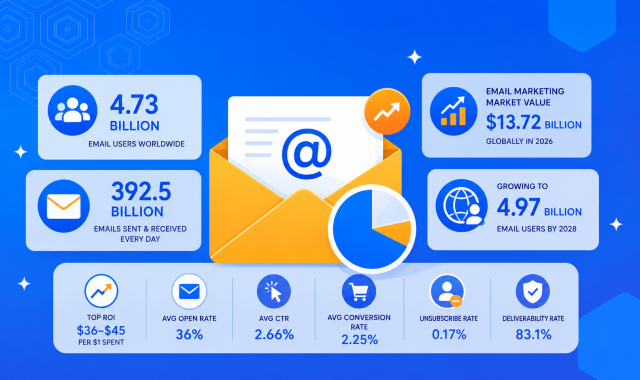
- According to multiple sources, including Benchmark Mail and overall internet searching, the average Return on Investment (ROI) in Email Marketing ranges between $36 to $42 (more specifically, $36-40) for every $1 expenditure.
- HubSpot Blog & Litmus generalized the range, citing 10:1 to 36:1 for most organizations, while the top ones go past 50:1.
- Forbes estimated the email marketing ROI to be $36 for every $1 spending.
- The average ROI for marketing emails in the US is 3600%, and in the UK, the ROI stands around 3800% (Email Monday).
- Campaign Monitor calculated that for every $1 spent, email marketing generates $38 in ROI.
MailPai agrees that the average Email Marketing ROI has been around $36-42 for a dollar, with $36 seems to be the most expected return, if proper procedures are followed.
Average & Highest Email Marketing ROI
| Average/Highest | ROI Amount | ROI Percentage |
| Email Marketing ROI Average | $36 – $42 for every $1 spent | 3600% – 4200% |
| Highest Email Marketing ROI | $45 – $72 for every $1 spent | 4500% – 7200% |
| Minimum Range of ROI for Email Marketing | $10 – $36 for every Dollar Cost | 1000% – 3600% |
Email Marketing ROI Percentage
When your $1 spending brings in an overall revenue of of $40, the ROI percentage is 3900%.
But, when the net profit (revenue-cost) is $40 for every $1 spend, the ROI percentage is 4000%.
As we’ve already mentioned, email marketing averages a whopping 3,600% to 4,200% ROI.
What is a Good ROI for Email Marketing?
| Period | Good ROI for Email Marketing | Percentage |
| 1st Year | $1-2 for every $1 | 100% to 200% |
| 2nd Year | $3-5 for every $1 | 300% to 500% |
| 3rd Year Onwards | $10-40+ for every $1 | 1000% to Over 4000% |
| Overall | $36-45 for every $1 | 3600% to 4500% |
A good ROI for email marketing typically ranges from 3,600% to 4,500%. It means that for every $1 spending, you will get a net profit return of $36 to $45. However, the ROI might not be the same from the very beginning. In the very first year, achieving a 100% to 200% ROI would be quite good. Because this is the time when you learn to build up an audience and convert them. Marketers should look for an ROI of 300% to 500% for the 2nd year of marketing. Then, when you have already learned optimized, organized, and established programming, you would definitely demand a 1,000% to 4,000%+ ROI mark.
Email Marketing ROI vs Social Media
| Performance Metrics | Email Marketing | Social Media Platforms (FB, X, Insta, etc.) |
| Return On Investment (ROI) | $36-45 for every $1 Cost | $2-5 for every $1 Cost |
| Conversion Rate | Up to 6-8% | Only 1-2% (Paid), Less than 0.5% (Organic) |
| Audience Reach | Around 25-43% on Average | Around 2% Only (Facebook) |
From the above chart, you can notice that email marketing yields a mammoth Return on Investment of $36-45 for every $1 Cost, which is an unbelievable 3600-4500%. While Social platforms only give back an ROI of $2-5 for a dollar, which is only confined within 200-500%. Thus, Email Marketing ROI is multiple times more than the ROI from social platforms. It’s a win-win situation for the email marketing marketers. And not only ROI, but also other core metrics like conversion rate, audience reach, etc., are a lot higher in the case of email marketing. For email marketing, MailPai can be your best bet with both free and paid versions available.
How can you increase ROI: Proven Strategies
Here are some proven strategies and secret techniques to increase or improve the ROI of your email marketing campaign.
Segmenting Email List
Segmentation is the process/practice of dividing your email contact list into specific groups based on different criteria. You can divide the list based on demographics, purchasing behavior, sign-up source, or engagement levels. The demographic segmentation mainly groups on the basis of age, gender, location, or occupation. Subscribers’ actions, previous purchases, website visiting, or mail interactions, etc., group them into various behavioral segments. Engagement level is another way to divide the audience into various segments based on regularly active, occasional opener, and completely inactive ones. Marketers can also segment their audience based on the sign-up sources (webinar, social media posts, or website pop-up, etc).
Highly Personalized Messages
One thing MailPai can ensure is that highly personalized emails bring you fruitful outcomes like higher email open rates, CTR, more sales, and better engagement. Use the recipient’s first name to start instead of a generalized one. Go for dynamic content by making changes to the parts of your content based on the recipient’s behavior or demographics. Because test, demand, priority, etc, differ from one recipient to another.
A/B Testing
It’s the practice of sending two version mails to different sublets and making a comparison of performances between the 2 types. Find out which sort has performed better on the basis of engagement, conversions, and other metrics. This practice helps you to take data-driven decisions for future marketing.
Automated Mails
Automation results in a guaranteed, consistent, timely, and personalized communication with the subscribers. This practice helps you welcome a new subscriber, enables you to automatically send a birthday wish or discount, while businesses can follow-up to an abandoned cart, and that too without any manual touch. Segmentation, personalization, timing, and monitoring are key practices related to email automation.
Well-designed mails with clickable content
Your mail should feature a clear & effective CTA (Call-To-Action), A/B test subject lines, Reader-focused pronouns (you/your), Humanly-written body, benefits over features (for products), etc., spark interest among recipients, and make them willing to open, click, and convert.
Timing
Even with the best content, you won’t get success if your timing sense is not good enough. Make sure to send when most people are online and when they are free enough to check your mail. As the outcomes differ based on industry and audience type, you may try different days of the week or different times of the day to observe when they are opening your mail more frequently.
Increasing Interaction
With more recipients or subscribers interacting, you can achieve your desired ROI. Segmenting mail list, removing inactive subscribers, optimizing CTAs, organizing embedding surveys & quizzes, and offering giveaways can make people more interactive with your content.
Decrease Subscriber Churn
When a subscriber stays longer in your list, it’s more likely to convert them into clients. Strategies like improved content relevance, lower email frequency for low-engagement segments, offering a preference center, etc., would help to do so.
Healthy & Engaged Email List
Using an email validation tool, a double opt-in confirmation process to collect new subscribers, an automated welcome email series, re-engagement email campaigns, etc., will keep your list healthy and engaged while increasing probability for the ROI.
Out of the Spam Box or Jump Folder
When your mail lands in the spam box of the recipients, you will find an excessively low open rate. Authentication of your domain with DKIM and SPF records, cleaning email list to avoid high bounce rate, sending from a domain matching your web domain name, linkage to reputable domains, etc., can really help.
FAQs
Find answers for some of the frequently asked questions regarding the email marketing ROI.
What is the full form of ROI in email marketing?
The full form of ROI in email marketing is “Return On Investment”.
How to calculate email ROI?
Subtract your Total Campaign Costs from your Email-Attributed Revenue, divide that number by your Total Campaign Costs, and multiply by 100 to get a percentage. The Email ROI calculation equation: {(Generated Revenue – Total Cost) ÷ Total Cost} × 100.
What does 20% ROI mean?
20% ROI means for every $1 you spend on your email campaigns, you earn $0.20 in pure profit.
Is a 40% ROI good?
40% ROI is not good enough for email marketing. Indeed, in email marketing, a good ROI is around 4000%. Keep in mind that $40 for every $1 is not equal to 40% ROI but equal to 4000%!
Is 100% ROI possible?
100% ROI means you get $1 pure return in profit for $1 spending. In Email Marketing, one can easily achieve 100% ROI; indeed, currently, a good ROI in this sector is around 3600% to 4200%.
What’s a realistic ROI?
A realistic ROI in email marketing is a minimum of $10-36 for every $1, which means 1000-3600%, while a good ROI is $36-42 for a dollar (3600-4200%).