
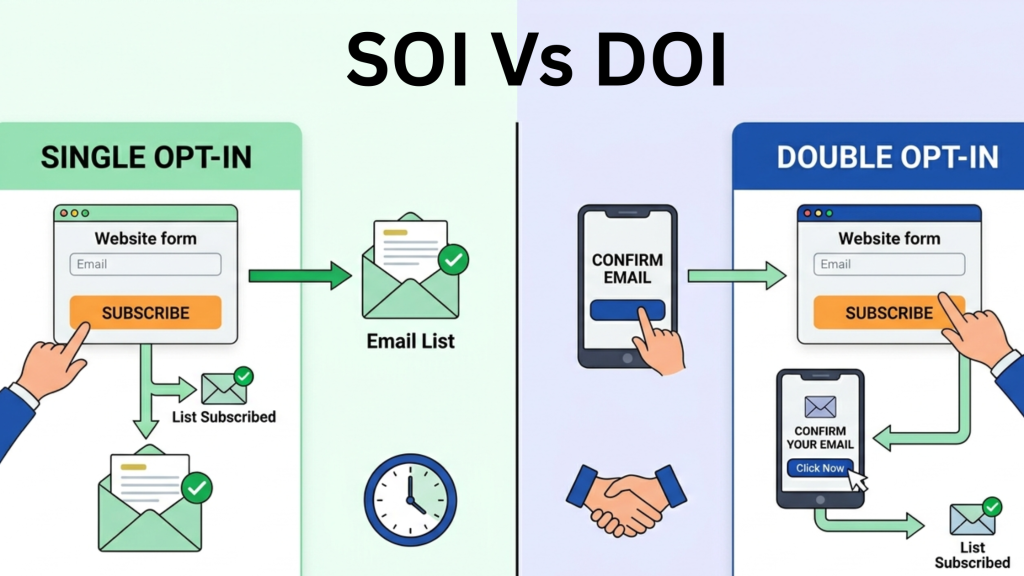
When someone joins your email list, there are usually two ways to set their subscription status to “subscribed”. With Single Opt-in, the contact is added directly to the email list immediately after submitting their email through a form, without any verification. With Double Opt-in, the system sends a confirmation email after the form submission. The user becomes a subscriber only after clicking the confirmation link in that email.
Neither method should simply be considered better. Instead, you should choose the one that best fits your specific needs and goals. The right choice depends on factors such as risk management, growth speed, contact quality, and your audience’s expectations.
Including MailPai, almost every modern email marketing tool offers these options to choose from. In this article, we will explain both methods, share real life experiences, and discuss the pros and cons of each approach.
What is Single opt-in?
In Single Opt-in, a user submits their email address (and any other required information) through a form and instantly added to the subscriber list. Although they may still receive a welcome email, their subscription does not depend on any additional action, such as clicking a confirmation link or verifying the email address.
What is Double opt-in?
In Double Opt-in, a user enters their email address through a form, and an automatic confirmation email is sent to that address. The user is added to the contact list as a “Subscriber” only after clicking the confirmation link in the email.
Single Opt-in Vs Double Opt-in: Pros and cons
Single opt-in
Pros
- Faster growth of the contact list
- Simple and easy process for users
- Useful when users are already registered or verified through another step
Cons
- Higher chance of collecting invalid email addresses
- Users may enter email addresses without real intent or interest
- Can lead to higher bounce rates and more spam complaints
- Higher bounce rates could be a cause of IP blocking and emails to be delivered to spam or junk folders.
Double opt-in
Pros
- Filters highly interested audiences, leading to higher open and click rates
- Removes invalid email addresses from the list
- A more reliable, long-term risk-free marketing approach
Cons
- The double-step verification process can feel time-consuming for users
- It may slow down the growth of the contact list
- Even genuinely interested users may fail to complete the confirmation step
Business Scenarios & Where Each Model Fits
Try Single Opt-in when
- Subscribers are already registered or verified on your site
- You collect emails from authentic sources or trusted live platforms
- You are running time-sensitive campaigns and need to reach a broader audience quickly
- You offer newsletter sign-ups only to logged-in users on your website or app
Try double opt-in when
- You are collecting user data from ads, social media campaigns, giveaways, or other external sources
- You want to build a highly engaged and genuinely interested customer base to ensure better long-term engagement
- You need to maintain higher list quality by reducing fake, invalid, or low-intent sign-ups
- Deliverability, trust, and sender reputation are important for your email marketing performance
From my experience, most of the reputed businesses try a hybrid approach. They use double opt-in for public sources like ads and social media to get genuine and high-quality subscribers. At the same time, they use single opt-in for product or transaction-based sign-ups, where users are already active and engaged with the platform.
Understanding Compliance
Global email marketing laws and regulations vary depending on the region, industry, and how you use the data. Clear consent, using reCAPTCHA during email collection, and including a physical address, unsubscribe link, and privacy policy in your email templates help ensure a safer email marketing practice.
Double opt-in is sometimes considered more GDPR-friendly, but it is not directly required for GDPR compliance, and single opt-in is not illegal. What matters most is how emails are collected and how responsibly they are used and managed.
How Tools Like MailPai Help Implement Your Strategy
Email marketing tools should not force a philosophy on you. MailPai is built so you can run the model that matches your risk level and audience:
- If you want double opt-in, you can enable it so subscribers must confirm before they are treated as fully added.
- If you want single opt-in, you can keep confirmations off for a smoother path from signup to first campaign.
That flexibility matters because businesses rarely have one rule forever.
FAQs
Is Double opt-in required?
Double opt-in is not mandatory, but it is considered a safer way to verify subscribers. It is widely seen as a best practice, and in some countries it is commonly used to stay aligned with stricter interpretations of email marketing laws and consent requirements.
Is Double opt-in (DOI) required by GDPR?
No, double opt-in is not required under GDPR.
The GDPR (General Data Protection Regulation) is a privacy law in the European Union that governs how personal data is collected, used, and protected. It does not specify whether businesses must use single or double opt-in. Instead, it focuses on whether users clearly agreed to receive emails, and whether the business can show proof of that agreement later if needed.
In practice, double opt-in is often used as a stronger way to prove consent, especially when collecting data from public sources. While it is not mandatory, it is generally considered a safer and more reliable method for building email lists.
Does single opt-in hurt deliverability?
Not by itself. Deliverability problems usually happens for low-quality email lists, high spam complaints, or not following proper email formatting and sending guidelines. In most cases, issues happen when emails are collected in bulk from unverified sources, users enter fake or incorrect addresses, or the list contains old and inactive email accounts.
Which Countries Require Double Opt-in?
Actually, there are no countries that legally require double opt-in. However, in countries like Germany, Austria, Greece, Luxembourg, Norway, Switzerland, and across much of Europe, it is widely used as a best practice. This is mainly because it provides stronger proof of user consent and helps reduce legal and compliance risks.
Is Single opt-in (SOI) illegal?
No, single opt-in is not illegal. It is a common practice in many businesses, but it must follow basic email marketing rules. What really matters is having clear user consent, including an unsubscribe option in every email, and maintaining transparent communication with your audience.




If you finds anything well in this comment, hopefully join this conversation.
What should I do when importing bulk email list from other sources? yes, buying buying email list usually don’t encourage by the marketers but there are many options to buy authentic email list. In that case what should I do? I have no options about single opt in or double opt in, that means I need to send them the email blindly. I think the software should manage this process and and remove email list those are bouncing or invalid. I am looking for that kind of tools which will handle and make the email list secure automatically.
Try to use another Connection (SMTP/API) to manage cold emails. It’s better to buy an additional relevant domain name for that particular outreach if you are serious about that. In that case, if anything went wrong, your main domain and transactional emails will keep safe. Mailpai have separate connection options to defend yourself.